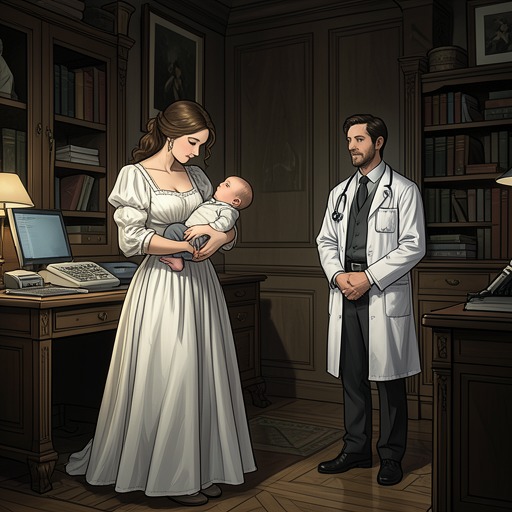
Roberto’s Birth
Like Water for ChocolateRoberto’s birth turns an unforeseen domestic emergency into a test of Tita’s resourcefulness and a turning point in her feelings toward her family. Left alone when Rosaura goes into labor, Tita must assist her without experience or a doctor present. Nacha’s remembered guidance helps her care for the newborn, while the child’s arrival awakens an affection that extends beyond him to Pedro and even to Rosaura.
Circumstances and isolation
The labor begins just after Tita has returned to her chores. Pedro calls for her in desperation: Rosaura has started labor, and he must travel to Eagle Pass to fetch John Brown, the family doctor. He asks Tita to look after her while he is gone. Tita has little desire to see the child, but there is no one else available to help. Mama Elena and Chencha have gone to buy supplies for the birth, delayed because federal troops had made travel through the village dangerous. They had not expected the baby to arrive so soon.
The absence of help becomes more serious as events unfold. Pedro is captured by federal troops and detained before he can bring back the doctor. Shooting breaks out in the village, preventing Mama Elena and Chencha from returning; they take refuge with the Lobos. Thus the woman who had hoped to stay only briefly at Rosaura’s bedside is left as the sole person present for the delivery. The danger is not the result of a planned intervention or a trained attendant’s work: it is a consequence of the family’s separation by labor, military detention, and violence.
Tita assists the delivery
Tita has seen animals being born, but she recognizes that watching them has not prepared her to deliver a human child. She has set out sheets, hot water, and sterilized scissors. She knows the umbilical cord must be cut, yet not when to do it or how much to cut, and she cannot recall the steps needed to care for the baby once he is born. Her schooling has given her facts such as the names of the planets and the contents of Carreno’s manual, but none of that tells her how to help Rosaura now.
With no practical instruction to rely on, Tita turns to Nacha, whose guidance she knows from the kitchen. She kneels and asks for help, reasoning that the woman who taught her recipes might also guide her through this emergency. The appeal connects two kinds of care: knowledge passed on through cooking and knowledge needed to bring a child safely into the world. When Tita looks again, the labor has advanced and the baby is emerging. She witnesses the birth and remembers her nephew’s head appearing as a hard-won arrival. In the crisis, her uncertainty gives way to decisive work.
Newborn care and medical aftermath
The baby’s cries fill an emptiness Tita had not recognized in herself. She discovers a new love for the child and for life, as well as renewed tenderness toward Pedro and an affection for Rosaura, whom she had long despised. She takes the newborn to his mother, and the sisters weep together while holding him. The birth has not erased their history, but it creates a moment of shared feeling between them.
Nacha’s instructions continue to guide Tita through the immediate care of the infant. She cuts the umbilical cord, cleans and dresses him, binds him, and wraps him so that he can sleep without scratching his face. When Mama Elena and Chencha finally return that night with the Lobos, they admire Tita’s work. Roberto is sleeping peacefully, securely wrapped like a taco. The careful sequence of ordinary tasks marks how far Tita has moved from her initial helplessness: she has learned what to do in the moment, then carried it out without assistance.
John Brown returns with Pedro the next day, after federal troops release him. His arrival relieves the family, who had feared for Pedro’s life, but Rosaura remains weak and swollen. John examines her and identifies the severity of what has happened: she suffered an attack of eclampsia that could have killed her. He is astonished that Tita managed the delivery calmly and deliberately under such difficult conditions. The later diagnosis makes clear that this was not simply a difficult birth that ended well; Rosaura’s survival had been at stake while Tita worked without medical support.
Consequences and significance
The event establishes Tita as capable of responding when the household’s usual authorities and resources are absent. Her knowledge is incomplete, but she acts, draws on Nacha’s remembered instruction, and learns through the demands of the birth itself. The scene places intimate, practical care beside formal medical judgment: Tita performs the delivery and newborn care, while John’s examination afterward reveals the danger Rosaura faced. Neither moment cancels the other; together they show both the force of Tita’s improvisation and the seriousness of the condition that required a doctor’s assessment.
Roberto’s arrival also alters Tita’s emotional relationships. Before the birth she does not care whether the baby is a boy or a girl and feels no interest in meeting him. Afterward, her love reaches the child, Pedro, and the sister she had resented. The baby’s presence makes possible a brief reconciliation in shared tears, while John’s admiration of Tita introduces another consequence: seeing her composure and beauty, he begins to regard her with a feeling that has been dormant since his wife’s death five years earlier. The birth therefore changes more than the family’s circumstances. It reveals Tita’s capacity for action, brings tenderness into a divided sisterly relationship, and becomes the occasion for John’s first renewed response to love.